How to Organize a Padel Tournament: Complete Step-by-Step Guide
Learn how to organize a successful padel tournament from start to finish. Covers planning, formats, scheduling, equipment, and tips for a smooth event.
By PadelMix · January 12, 2026
Organizing a padel tournament is a rewarding experience that brings players together for competition and fun. Whether you’re planning a casual club event, a corporate team-building day, or a competitive tournament, this guide covers everything you need to know to run a successful event from start to finish.
Step 1: Define Your Tournament Goals
Before diving into logistics, clarify what you want to achieve with your tournament:
Tournament Type
- Social/Recreational: Focus on fun, mixing players, and creating a relaxed atmosphere. Ideal for club nights, company events, or community gatherings.
- Competitive: Emphasize fair competition and accurate rankings. Best for league events, club championships, or ranked tournaments.
- Learning/Development: Designed to help newer players gain experience. Mix skill levels intentionally to encourage learning.
Participant Considerations
- Expected number of players: Determine your target group size (8, 12, 16, 20+ players)
- Skill level range: Are players beginners, intermediates, advanced, or mixed?
- Player demographics: Consider age groups, gender mix, and whether you want singles or mixed doubles
Step 2: Choose a Tournament Format
Selecting the right format is crucial for your tournament’s success. Here are the most popular options:
Americano
Americano is the most popular social tournament format. Players rotate partners randomly each round, playing with and against everyone throughout the event.
Best for: Social events, mixed skill levels, smaller groups (4-16 players)
Key features:
- Random partner rotation
- Individual scoring
- Maximum social interaction
- Works with any group size divisible by 4
For detailed setup instructions, see our Americano tournament guide.
Mexicano
Mexicano adds skill-based matchmaking to the Americano format. After the first round, pairings are determined by current scores, creating more balanced matches.
Best for: Competitive events, varied skill levels, larger groups (12+ players)
Key features:
- Dynamic, score-based matchmaking
- Progressively balanced competition
- Fair for all skill levels
- Requires minimum 8 players
Mixed Americano
Mixed Americano ensures gender-balanced teams throughout the tournament. Each pair consists of one male and one female player.
Best for: Mixed doubles events, social gatherings, couples tournaments
Key features:
- Gender-balanced teams every round
- Equal number of male and female players required
- Separate winners for each gender category
Beat the Box
Beat the Box combines elements of Americano and Mexicano by dividing players into “boxes” (groups). Players compete within their box, with top performers moving up to higher boxes and lower scorers moving down.
Best for: Large tournaments (16+ players), mixed skill levels, multi-round events
Key features:
- Box-based progression system
- Natural skill grouping over time
- Combines social variety with competitive balance
- Minimum 8 players required
Traditional Bracket
Classic elimination or round-robin bracket tournament with fixed teams throughout.
Best for: Established pairs, competitive rankings, league play
Key features:
- Teams stay together
- Clear progression through rounds
- Familiar format for competitive players
Not sure which to choose? Check our Americano vs Mexicano comparison to understand the key differences.
Step 3: Plan the Logistics
Venue Requirements
- Court availability: Calculate courts needed based on format and player count. For Americano/Mexicano, plan for 1 court per 4 players.
- Court booking: Reserve courts for your estimated tournament duration plus buffer time
- Indoor vs outdoor: Consider weather contingencies for outdoor venues
- Amenities: Check for changing rooms, seating areas, and parking
Date and Time Selection
- Duration estimate: A typical Americano tournament with 12-16 players takes 2-3 hours
- Time of day: Evening events work well for working professionals
- Season: Consider weather and daylight if playing outdoors
- Competing events: Avoid conflicts with major sporting events or holidays
Equipment Checklist
- Balls: Have plenty of padel balls available (4-6 per court minimum)
- Scoreboard: Physical or digital scoreboards for each court
- Score sheets: Backup paper scoring if using manual tracking
- Prizes: Trophies, medals, or gift prizes for winners
- First aid kit: Basic supplies for minor injuries
- Refreshments: Water, drinks, and snacks for participants
Step 4: Set Up Registration
Registration Process
Create a clear registration system that collects:
- Player names and contact information
- Skill level (self-assessment or rating)
- Partner preferences (for fixed-team formats)
- Payment (if applicable)
- Dietary requirements (if providing food)
Communication
- Send confirmation emails with tournament details
- Provide clear information about format, timing, and what to bring
- Create a group chat or communication channel for updates
- Send reminders 1 week and 1 day before the event
Step 5: Create the Schedule
Scheduling Principles
- Match duration: Plan for 10-15 minutes per match (24-32 points)
- Rest time: Allow 5-10 minutes between rounds for players to recover
- Buffer time: Add extra time for delays and tiebreakers
- Staggered starts: If using multiple courts, stagger match starts for smoother transitions
Tools for Scheduling
Creating a balanced schedule manually can be complex. Consider using:
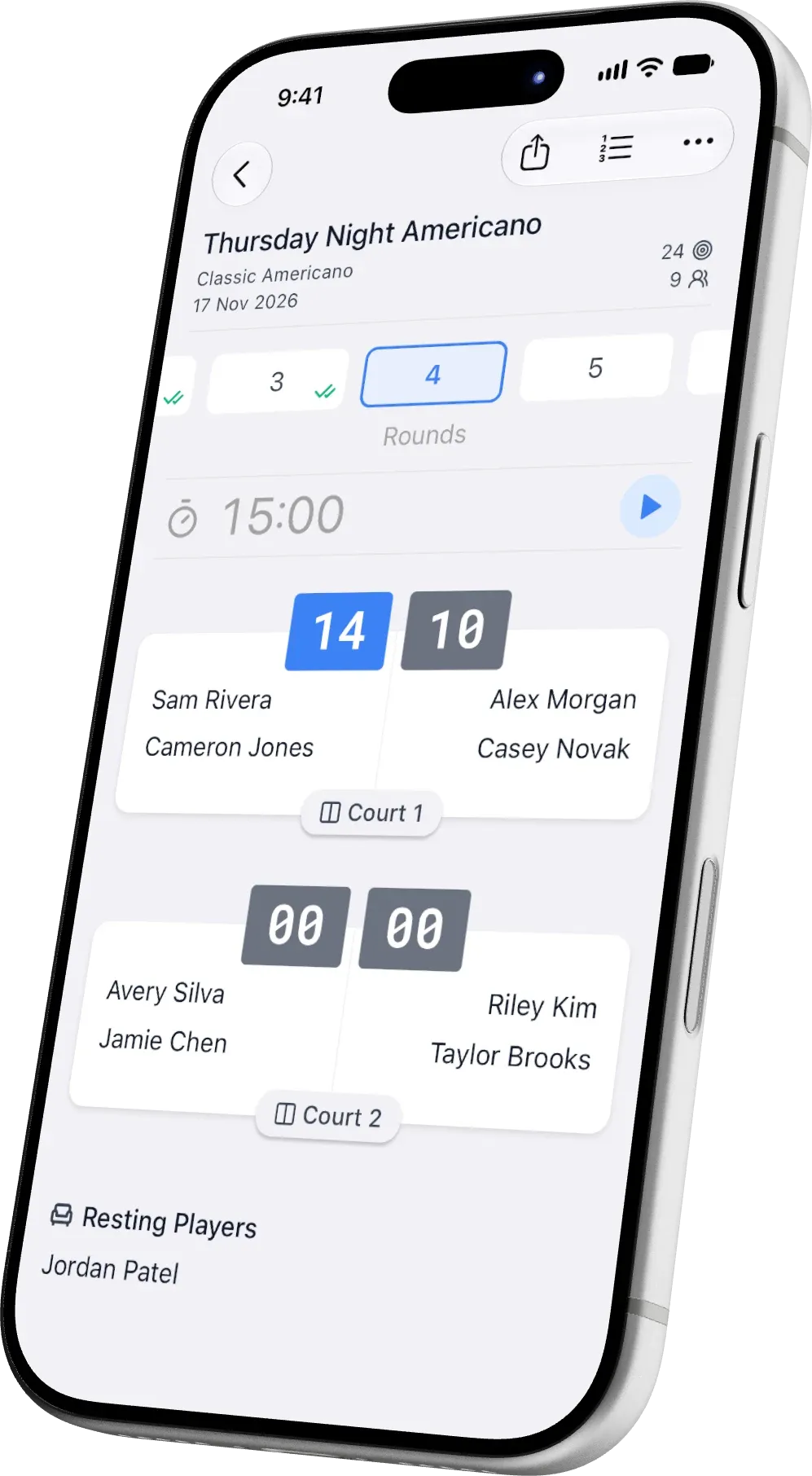
- PadelMix app: Automatically generates match schedules for Americano, Mexicano, and other formats
- Excel templates: Pre-built spreadsheets for manual tournament management
- Printed brackets: Simple option for traditional elimination tournaments
Step 6: Run the Tournament
Pre-Tournament Briefing
Gather all players and cover:
- Tournament format and rules
- Match duration and scoring system
- Court assignments and rotation system
- Where to report scores
- Safety and etiquette reminders
During the Tournament
- Announce matchups clearly before each round
- Track scores in real-time to maintain accurate standings
- Keep players informed of next matches and current rankings
- Handle disputes fairly and make quick decisions
- Maintain energy with music, announcements, and encouragement
Managing Score Tracking
Accurate score tracking is essential. Options include:
- PadelMix app: Automatic calculations and real-time standings
- Spreadsheet: Manual entry with formulas for totals
- Whiteboard: Visual scoreboard visible to all players
- Paper sheets: Simple but requires manual calculation
Step 7: Award and Wrap-Up
Prize Distribution
- Announce final standings clearly
- Award prizes to top finishers (typically top 3)
- Consider fun awards: best sportsmanship, most improved, best outfit
- Thank sponsors if applicable
Post-Tournament
- Share final results via email or group chat
- Post photos and highlights (with permission)
- Gather feedback for future improvements
- Thank participants and volunteers
- Schedule the next event while enthusiasm is high
Common Mistakes to Avoid
Planning Errors
- Underestimating time: Add 20-30% buffer to your time estimates
- Wrong format choice: Match format to your group’s goals and skill levels
- Insufficient courts: Don’t squeeze too many players onto too few courts
Execution Errors
- Unclear rules: Explain the format thoroughly before starting
- Poor communication: Keep players informed throughout
- Inconsistent scoring: Use one reliable system and stick to it
- Ignoring skill gaps: Consider Mexicano format if skill levels vary significantly
Organizational Errors
- No backup plan: Have contingencies for weather, no-shows, and equipment issues
- Forgetting breaks: Players need water and rest between matches
- Last-minute changes: Communicate schedule changes immediately
How PadelMix Simplifies Tournament Organization
Managing all these details can be overwhelming, which is why PadelMix was created to handle the complexity for you.
With PadelMix, you can:
- Generate match schedules instantly for any format (Americano, Mexicano, Mixed, Team)
- Track scores in real-time with automatic standings calculations
- Handle any group size from 4 players to large tournaments
- Share live results so players can follow along on their phones
- Focus on the event instead of juggling spreadsheets and calculations
Whether you’re organizing your first tournament or your fiftieth, PadelMix makes it effortless.
Download PadelMix today and experience stress-free tournament management!
 Google Play