King of the Hill is a promotion and demotion padel tournament format where courts are ranked hierarchically. The top court is called the Winners Court — “the hill” — and the goal of every player is to reach it and stay there. After each round, winners move up to a higher court and losers drop down to a lower one. The team holding the Winners Court at the end of the final round wins the tournament. King of the Hill is also commonly known as Winners Lane or Winners Court format.
Unlike Americano or Mexicano, where the winner is determined purely by total points, King of the Hill adds a second competitive axis: the physical position on the court hierarchy. Points still accumulate across all rounds, but what ultimately matters is who controls the top court when the final whistle blows.
Courts are numbered from 0 (the Winners Court) down to N-1 (the lowest court). Each court hosts 4 players per round, randomly paired into 2 teams. After the match, the winning team moves up one court and the losing team moves down one — except at the extremes:
Partners are re-randomised every round, just like Mexicano. Rounds are generated one at a time based on results — there is no pre-set schedule for the whole tournament.
After each round, teams move based on the result:
| Court | Result | Movement |
|---|---|---|
| Winners Court (top) | Win | Stays — still the King |
| Winners Court (top) | Lose | Moves down one court |
| Middle court | Win | Moves up one court |
| Middle court | Lose | Moves down one court |
| Lowest court | Win | Moves up one court |
| Lowest court | Lose | Stays (standard format) |
Tie: If both teams on a court finish equal on points, both stay on the same court for the next round.
Collision: When a team is promoted to a court that is already fully occupied (because a tie left both teams there), the promoted team evicts one of the tied teams back to their original court. The evicted team is typically the one with fewer total accumulated points across the tournament.
The Challenger format activates automatically when there are more players than courts can accommodate at once (i.e., when the number of players exceeds courts × 4):
This makes King of the Hill playable with larger groups — for example, 12 players on 2 courts, where 4 players rotate through the sitout pool each round.
pointsForSitout bonus while waiting in the Challenger pool.Here are the key things to plan when hosting a King of the Hill event:
| Feature | Americano | Mexicano | King of the Hill |
|---|---|---|---|
| Partner rotation | Every round | Every round | Every round |
| Matchup pairing | Random | Score-based | Court-based |
| Winner determined by | Total points | Total points | Holds Winners Court at end |
| Skill balancing | None | Score pairing | Court promotion/demotion |
| Minimum players | 4 | 4 | 8 (2 courts) |
| Overflow players | Not supported | Not supported | Challenger format |
| Tournament stages | 1 (continuous) | 1 (continuous) | 1 (continuous) |
King of the Hill is ideal when you want a format that feels more competitive and positional than standard Americano or Mexicano — the court rankings create a natural drama as players fight for the top spot. For other formats, check out Americano, Mexicano, or Beat the Box.
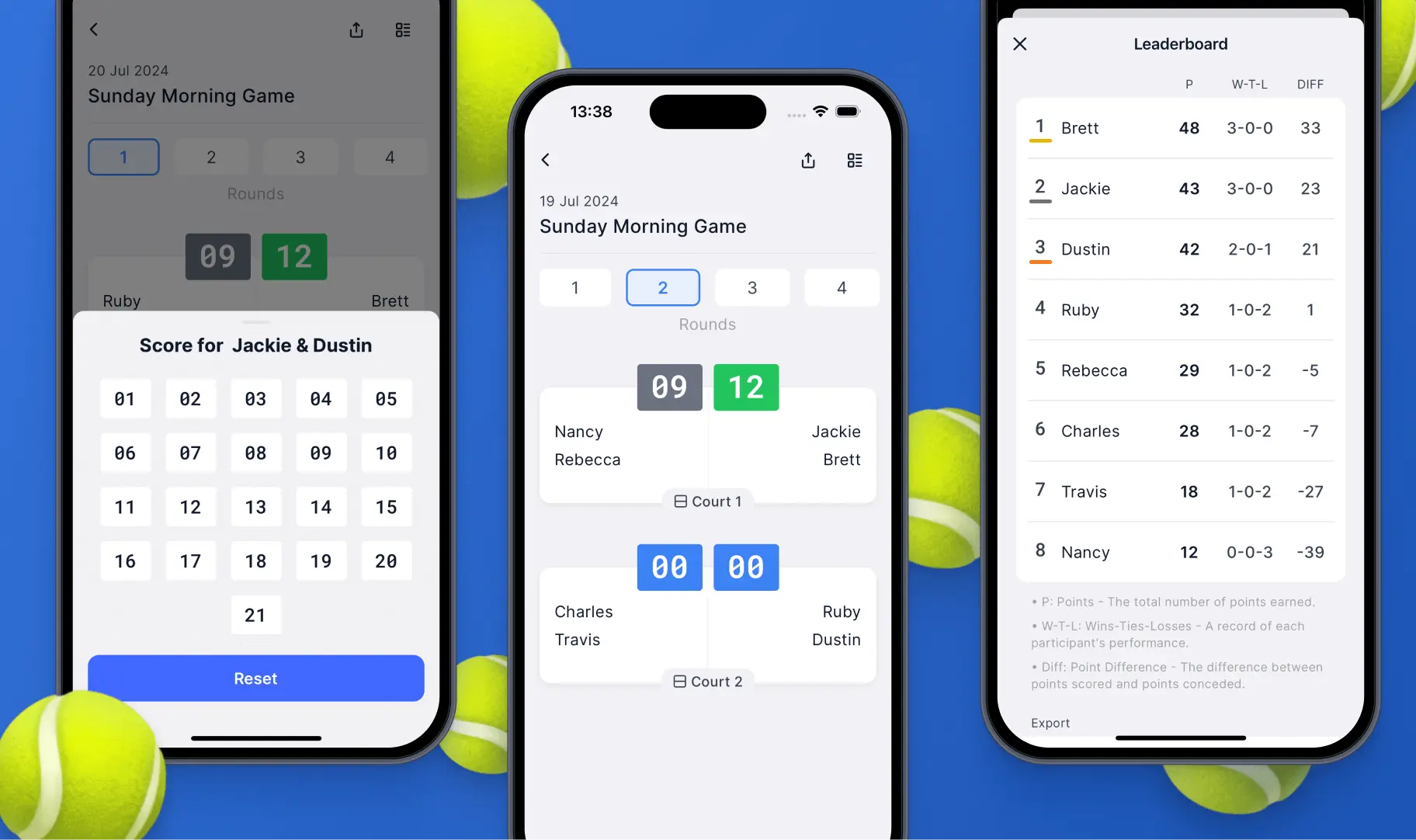
Managing court promotions, demotions, and the Challenger pool by hand can get complicated quickly. PadelMix handles all of it automatically:
Download PadelMix today and run your next King of the Hill tournament without the hassle!
Better way to Organize your Next Tournament
We built PadelMix to simplify the process of organizing and managing Padel tournaments. With PadelMix, you can create tournaments, enter scores, and track results in real-time.
Download PadelMix and start organizing your first Padel tournament today, all from your phone.